MTH1W, Grade 9, Mathematics
MTH1W COURSE OUTLINE
Course Title: Mathematics
Grade: 9
Ministry Course Code: MTH1W
Course Type: Open
Credit Value: 1.00
Course Hours: 112
Department: Mathematics
Revision Date: N/A
Policy Document:
Mathematics Grade 9, 2021
Prerequisite: None
COURSE DESCRIPTION
This course enables students to consolidate, and continue to develop, an understanding of mathematical concepts related to number sense and operations, algebra, measurement, geometry, data, probability, and financial literacy. Students will use mathematical processes, mathematical modelling, and coding to make sense of the mathematics they are learning and to apply their understanding to culturally responsive and relevant real-world situations. Students will continue to enhance their mathematical reasoning skills, including proportional reasoning, spatial reasoning, and algebraic reasoning, as they solve problems and communicate their thinking.
OVERALL EXPECTATIONS
Social-Emotional Learning Skills in Mathematics
Throughout the end of this course, students will:
AA1. develop and explore a variety of social-emotional learning skills in a context that supports and reflects this learning in connection with the expectations across all other strands
Mathematical Thinking and Making Connections
Throughout this course, students will:
A1. apply the mathematical processes to develop a conceptual understanding of, and procedural fluency with, the mathematics they are learning
A2. make connections between mathematics and various knowledge systems, their lived experiences, and various real-life applications of mathematics, including careers
Number
By the end of this course, students will:
B1. demonstrate an understanding of the development and use of numbers, and make connections between sets of numbers
B2. represent numbers in various ways, evaluate powers, and simplify expressions by using the relationships between powers and their exponents
B3. apply an understanding of rational numbers, ratios, rates, percentages, and proportions, in various mathematical contexts, and to solve problems
Algebra
By the end of this course, students will:
C1. demonstrate an understanding of the development and use of algebraic concepts and of their connection to numbers, using various tools and representations
C2. apply coding skills to represent mathematical concepts and relationships dynamically, and to solve problems, in algebra and across the other strands
C3. represent and compare linear and non-linear relations that model real-life situations, and use these representations to make predictions
C4. demonstrate an understanding of the characteristics of various representations of linear and non-linear relations, using tools, including coding when appropriate
Data
By the end of this course, students will:
D1. describe the collection and use of data, and represent and analyse data involving one and two variables
D2. apply the process of mathematical modelling, using data and mathematical concepts from other strands, to represent, analyse, make predictions, and provide insight into real-life situations
Geometry and Measurement
By the end of this course, students will:
E1. demonstrate an understanding of the development and use of geometric and measurement relationships, and apply these relationships to solve problems, including problems involving real-life situations
Financial Literacy
By the end of this course, students will:
F1. demonstrate the knowledge and skills needed to make informed financial decisions
OUTLINE OF COURSE CONTENT

.
.
EVALUATION SCHEME
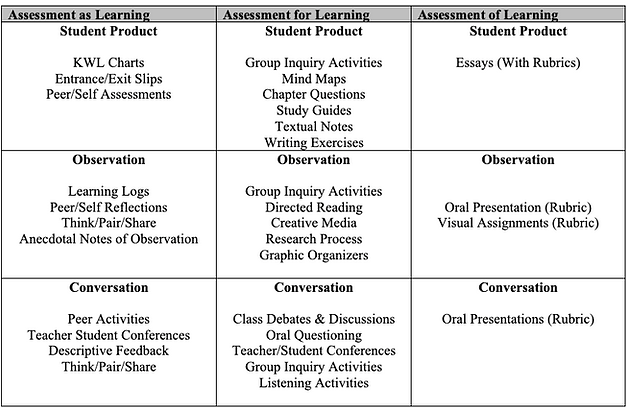
A final grade (percentage mark) is calculated at the end of the course and reflects the quality of the student’s achievement of the overall expectations of the course, in accordance with the provincial curriculum.
The final grade will be determined as follows:
Seventy percent (70%) of the grade will be based on evaluation conducted throughout the course. This portion of the grade should reflect the student’s most consistent level of achievement throughout the course, although special consideration should be given to more recent evidence of achievement.
Thirty percent (30%) of the grade will be based on a final evaluation administered at or towards the end of the course. This evaluation will be based on evidence from one or a combination of the following: an examination, a performance, an essay, and/or another method of evaluation suitable to the course content. The final evaluation allows the student an opportunity to demonstrate comprehensive achievement of the overall expectations for the course.