SPH3U, Grade 11, Physics
SPH3U COURSE OUTLINE
Course Title: Physics
Grade: 11
Ministry Course Code: SPH3U
Course Type: Academic
Credit Value: 1.00
Course Hours: 110
Department: Science
Revision Date: N/A
Policy Document: Science, The Ontario Curriculum, Grades 11 and 12, 2008 (Revised)
http://www.edu.gov.on.ca/eng/curriculum/secondary/2009science11_12.pdf
COURSE DESCRIPTION
This course develops students’ understanding of the basic concepts of physics. Students will explore kinematics, with an emphasis on linear motion; different kinds of forces; energy transformations; the properties of mechanical waves and sound; and electricity and magnetism. They will enhance their scientific investigation skills as they test laws of physics. In addition, they will analyse the interrelationships between physics and technology, and consider the impact of technological applications of physics on society and the environment.
OVERALL EXPECTATIONS
Scientific Investigation Skills And Career Exploration
By the end of this course, students will:
1. A1. demonstrate scientific investigation skills (related to both inquiry and research) in the four areas of skills (initiating and planning, performing and recording, analysing and interpreting, and communicating);
2. A2. identify and describe careers related to the fields of science under study, and describe the contributions of scientists, including Canadians, to those fields.
Kinematics
By the end of this course, students will:
1. B1. analyse technologies that apply concepts related to kinematics, and assess the technologies’ social and environmental impact;
2. B2. investigate, in qualitative and quantitative terms, uniform and non-uniform linear motion, and solve related problems;
3. B3. Demonstrate an understanding of uniform and non-uniform linear motion, in one and two dimensions.
Forces
By the end of this course, students will:
1. C1. analyse and propose improvements to technologies that apply concepts related to dynamics and Newton’s laws, and assess the technologies’ social and environmental impact;
2. C2. investigate, in qualitative and quantitative terms, net force, acceleration, and mass, and solve related problems;
3. C3. demonstrateanunderstandingoftherelationshipbetweenchangesinvelocityandunbalanced forces in one dimension.
Energy & Society
By the end of this course, students will:
1. D1. analyse technologies that apply principles of and concepts related to energy transformations, and assess the technologies’ social and environmental impact;
2. D2. Investigate energy transformations and the law of conservation of energy, and solve related problems;
3. D3. Demonstrate an understanding of work, efficiency, power, gravitational potential energy,kinetic energy, nuclear energy, and thermal energy and its transfer (heat).
Waves & Sound
By the end of this course, students will:
E1. analyse how mechanical waves and sound affect technology, structures, society, and the environment, and assess ways of reducing their negative effects;
E2. investigate, in qualitative and quantitative terms, the properties of mechanical waves and sound, and solve related problems;
E3. demonstrate an understanding of the properties of mechanical waves and sound and of the principles underlying their production, transmission, interaction, and reception.
Electricity & Magnetism
By the end of this course, students will:
F1. analyse the social, economic, and environmental impact of electrical energy production and technologies related to electromagnetism, and propose ways to improve the sustainability of electrical energy production;
F2. investigate, in qualitative and quantitative terms, magnetic fields and electric circuits, and solve related problems;
F3. demonstrate an understanding of the properties of magnetic fields, the principles of current and electron flow, and the operation of selected technologies that use these properties and principles to produce and transmit electrical energy.
OUTLINE OF COURSE CONTENT

.
.
EVALUATION SCHEME
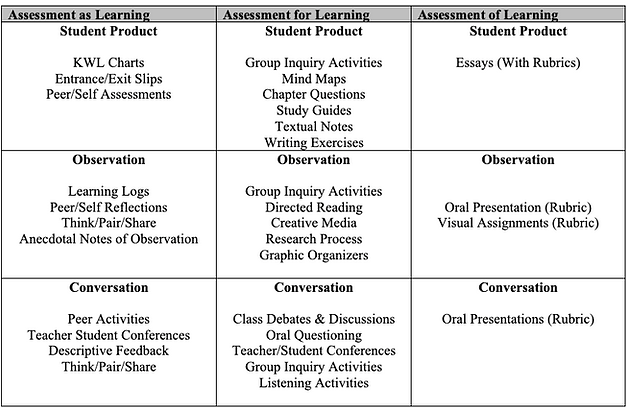
A final grade (percentage mark) is calculated at the end of the course and reflects the quality of the student’s achievement of the overall expectations of the course, in accordance with the provincial curriculum.
The final grade will be determined as follows:
Seventy percent (70%) of the grade will be based on evaluation conducted throughout the course. This portion of the grade should reflect the student’s most consistent level of achievement throughout the course, although special consideration should be given to more recent evidence of achievement.
Thirty percent (30%) of the grade will be based on a final evaluation administered at or towards the end of the course. This evaluation will be based on evidence from one or a combination of the following: an examination, a performance, an essay, and/or another method of evaluation suitable to the course content. The final evaluation allows the student an opportunity to demonstrate comprehensive achievement of the overall expectations for the course.